
And now for something completely different. Last year, some of you may have seen an article over on PetaPixel, discussing the Sigma Mark-I camera, a beautiful film body from the 1970s. In that article, a brochure of the Sigma lens system at the time was shown, and I was intrigued. While Sigma today has become one of the premier lens makers in the industry, in the 1970s, they were a new optical company content to fill the third party niche. Most of those old lenses are found in bargain bins in camera stores, usually beat up, low quality optics that were sold to the masses as a cheaper option to OEM glass. However, they did try to make ‘professional’ optics at this time, and the XQ designation was used for their premium lenses. Despite Sigma’s current reputation, these older manual focus lenses are not generally coveted by vintage lens shooters today.
Some of that is because the lenses were not generally as good as the lenses from Canon, Nikon, Olympus, Minolta and Pentax at the time, and so most modern shooters will gravitate towards the OEM lens brands to adapt. Another factor is that the XQ lenses were priced higher than the budget level, and as they were often inferior to the OEM solutions, not too many were sold. Those that were often were treated poorly over the years, and so copies that are available today are often beat up or broken.
Sigma XQ 18mm f/3.2
In browsing that brochure I mentioned above, the 18mm f/3.2 XQ caught my eye, and I was intrigued. In doing some research, this lens went through several small revisions (with the same optics), adding multi-coating, and changing some nomenclature. The design was also licensed to Spiratone, so the Spiratone 18mm f/3.5 is the same lens as the Sigma XQ. Being a quite wide 18mm, which was very wide in the mid 1970s, the XQ 18mm f/3.2 didn’t sell too many copies. I can’t find exact production numbers, but based on snippets of what I have found, it likely wasn’t more than a few thousand copies. So I was surprised when I went on eBay to find the only available copy of the lens was not only in good condition – it was new old stock.
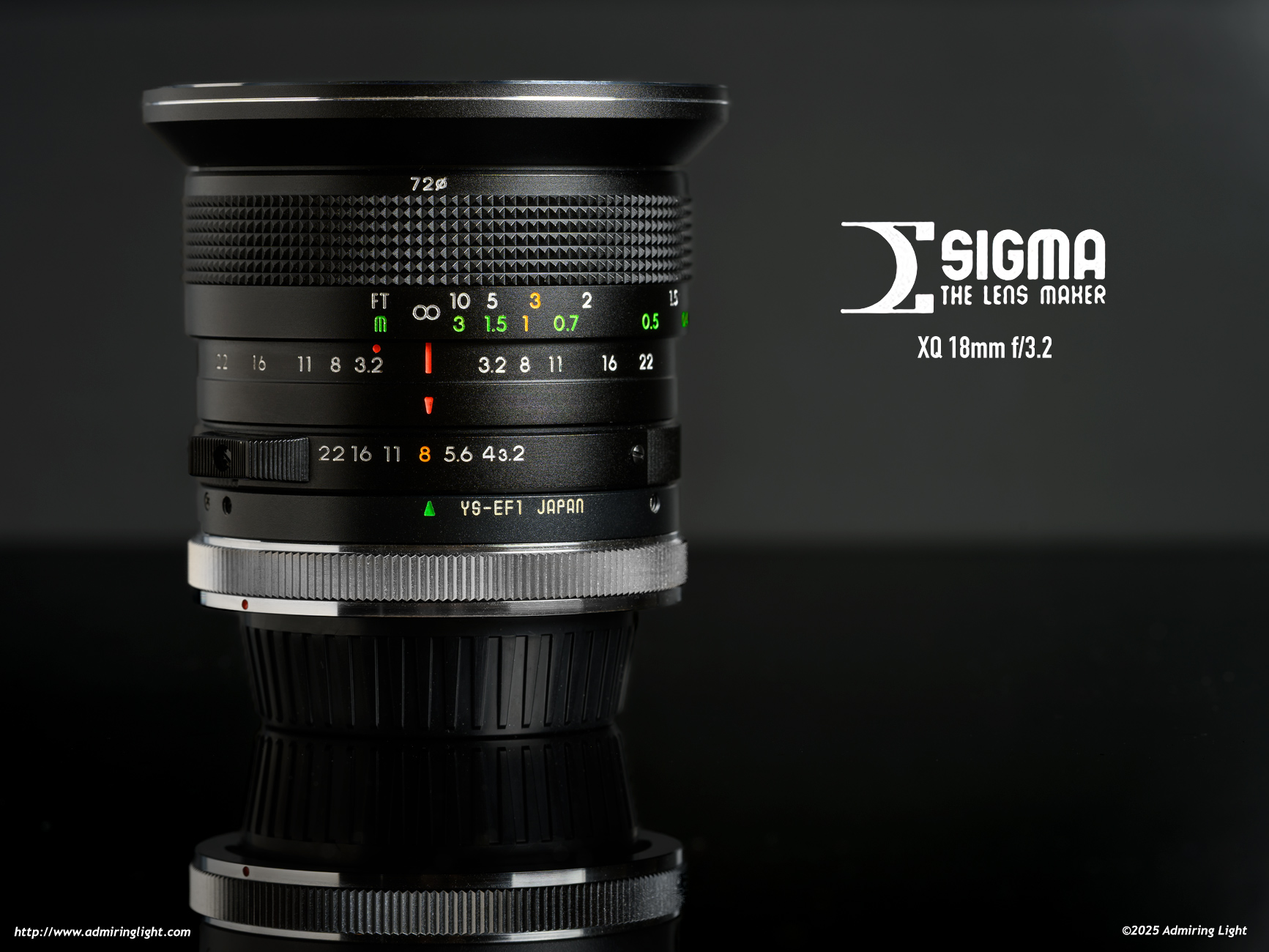
So I bought it for $75, and it arrived how it was packaged back in 1975. My example is, as you’d expect from NOS, pristine. Despite sitting in a box for 50 years, the lens aperture is snappy and oil free, and the focus helicoid is perfectly damped and buttery smooth. As you’ll see, as a third-party ultra-wide from the 1970s, the optics are nothing to write home about, but the build is wonderful. The lens is gorgeous to look at, and the metal engraved lens cap and even the plastic rear lens cap is really cool looking. The XQ lenses were made in YS mount, which was similar to Tamron’s adaptall mount. This copy (as well as the 28mm f/2.8 I’ll discuss in a bit) is Canon FD mount, so the lens has an attached YS-EF1 mount adapter as part of the assembly (EF1 to mean it would work on the Canon EF or Canon F-1 cameras, both FD mount, and nothing to do with the later Canon EF mount).
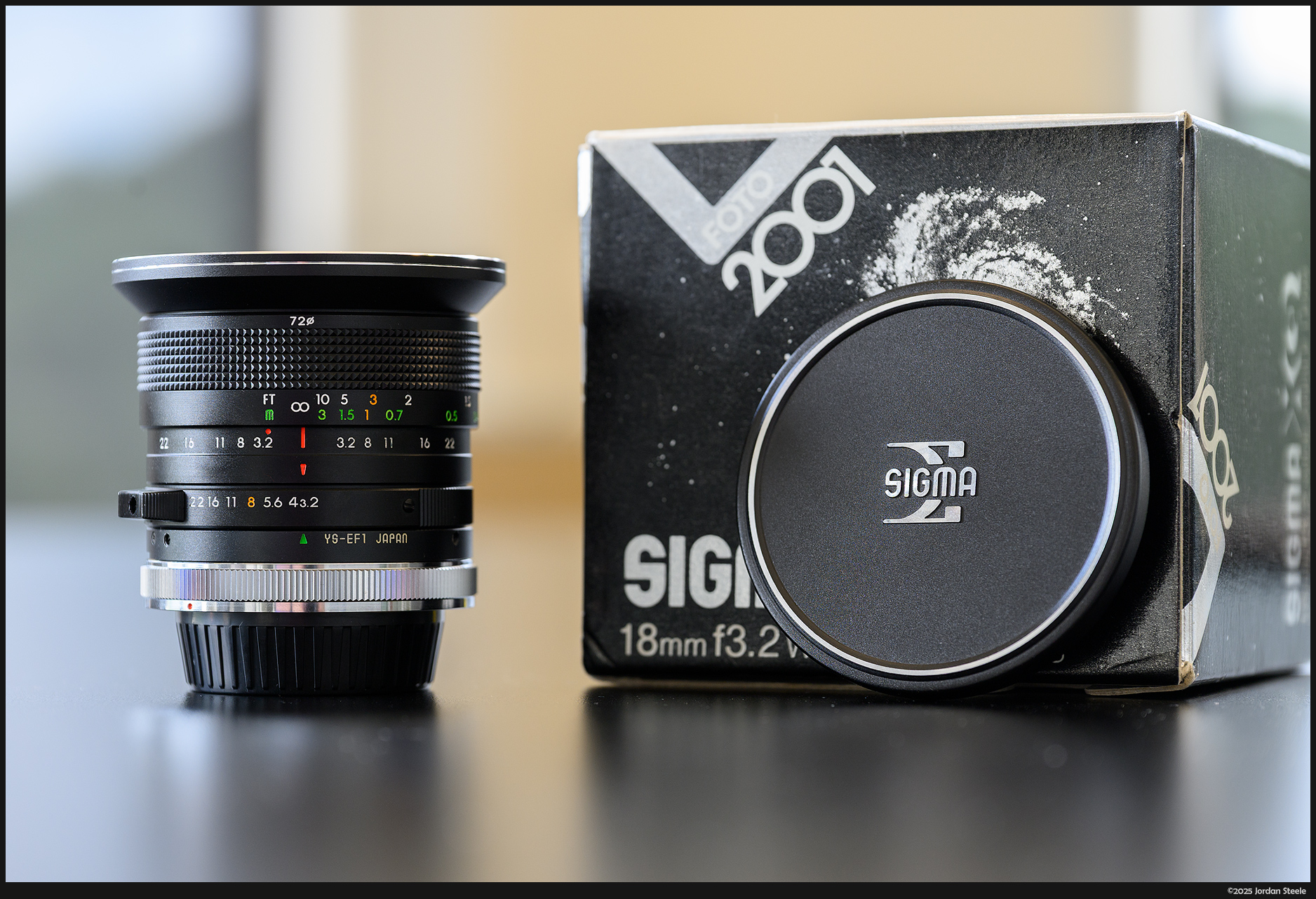
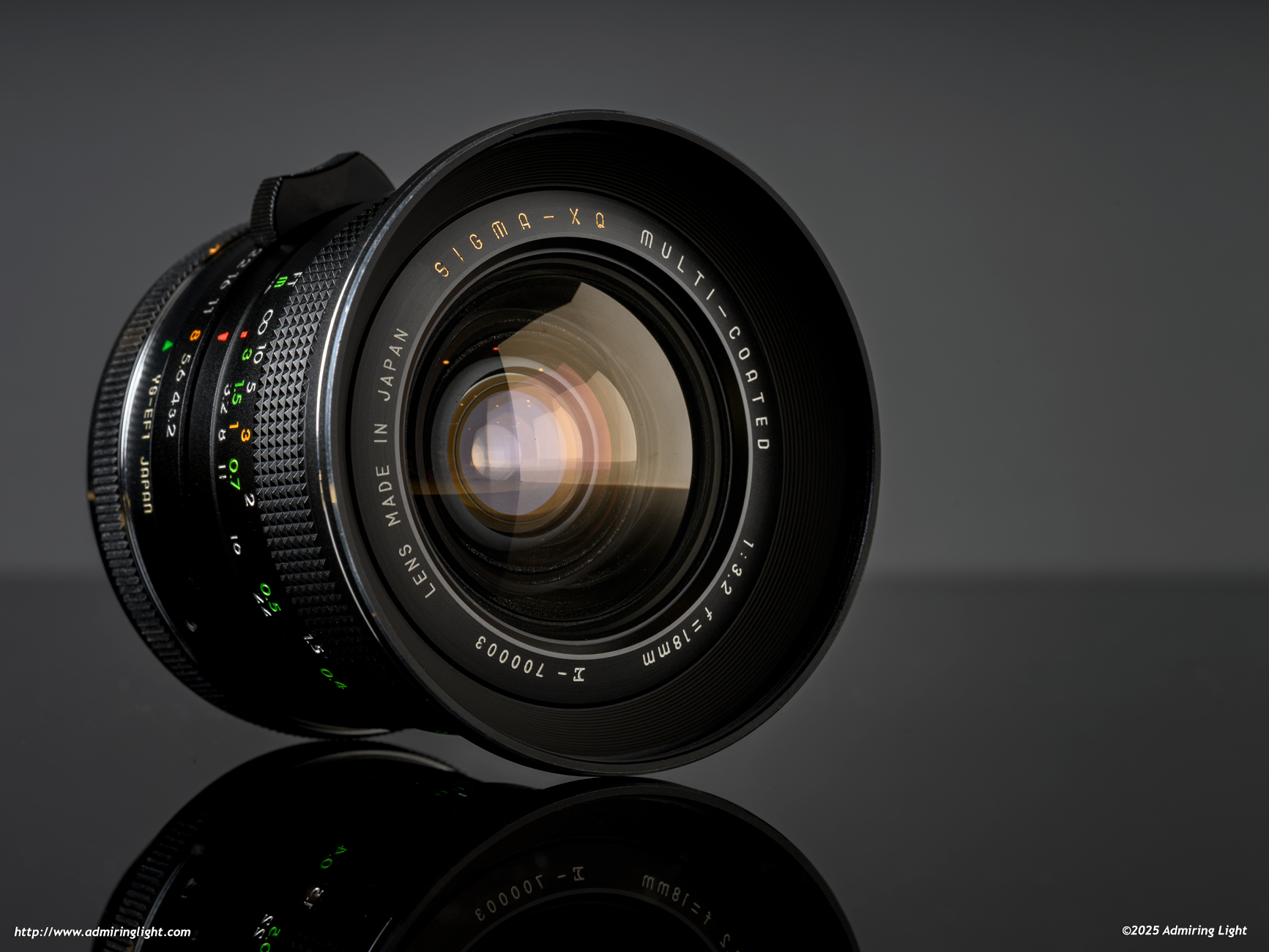
I have to say, unboxing and looking at a 50 year old lens that is actually brand new is quite different. The box had aged of course, and the original silica gel packet was brown. I didn’t buy the lens from a store going out of business, so it had changed hands at some point, but it also appeared that it had never been mounted to a camera before. The lens is marked “Sigma-XQ Multi-Coated” on the front ring, which makes this the fourth and final revision of the 18mm f/3.2 to be made by Sigma. Earlier lenses were called Widerama, or just had ‘Multi’ for the first multicoated version. This edition debuted in 1975. The lens is serial #700003. So, the 3rd lens off the line in the serial #700 series. Could this be the third copy produced of the Sigma-XQ Multi-Coated? Maybe. However, Sigma’s serial numbers are kind of all over the place, and the 700 series numbers were also used for other lenses. In any case, it’s a cool number to have on the lens too.
So I popped the XQ 18mm on my mirrorless Nikon Z6 III and took it for a spin. How does it fare compared to modern ultra-wide lenses? Well, very, very poorly in strict terms. The lens has reasonable sharpness in the center of the frame, but the edges and corners are quite soft. Stopped down, the edges can move to ‘ok’ levels, but the corners remain soft at any aperture. Color and contrast are pretty good, provided you aren’t shooting into the sun. The lens has some visible barrel distortion, but it isn’t extreme. What IS extreme, however, is the simply staggering amount of lens flare produced by the 18mm f/3.2 when shooting into bright light. Veiling flare reduces contrast across the entire frame and huge flare ghosts are everywhere. However, the overall effect is so extreme it actually looks kind of cool, so it isn’t a bad lens to use if you want a vintage JJ Abrams sort of feel.

Shoot away from the sun, and it can produce decent images, albeit with fairly soft details. I’ve applied a film grain to this image to add to its vintage flavor and obscure some of the softness.

Sigma XQ 28mm f/2.8 Filtermatic
I then looked around for other Sigma XQ lenses, and found another new-old-stock lens: the XQ 28mm f/2.8 Filtermatic, for just $50. Some of you may be familiar with Sigma’s filtermatic series. I had previously owned a filtermatic 16mm fisheye, which was actually a pretty decent lens. The filtermatic lenses have a rotating filter system allowing you to swap between clear, yellow, orange or blue filters for use with black and white film. It’s a rather ingenious system, which switches the filters internally by rotating the ring at the very front of the lens. Of course this copy’s filters work perfectly. Like the 18mm, this 28mm copy is pristine, and has a wonderfully damped and smooth focus ring, with a snappy aperture ring and smooth locking filter rotation ring.
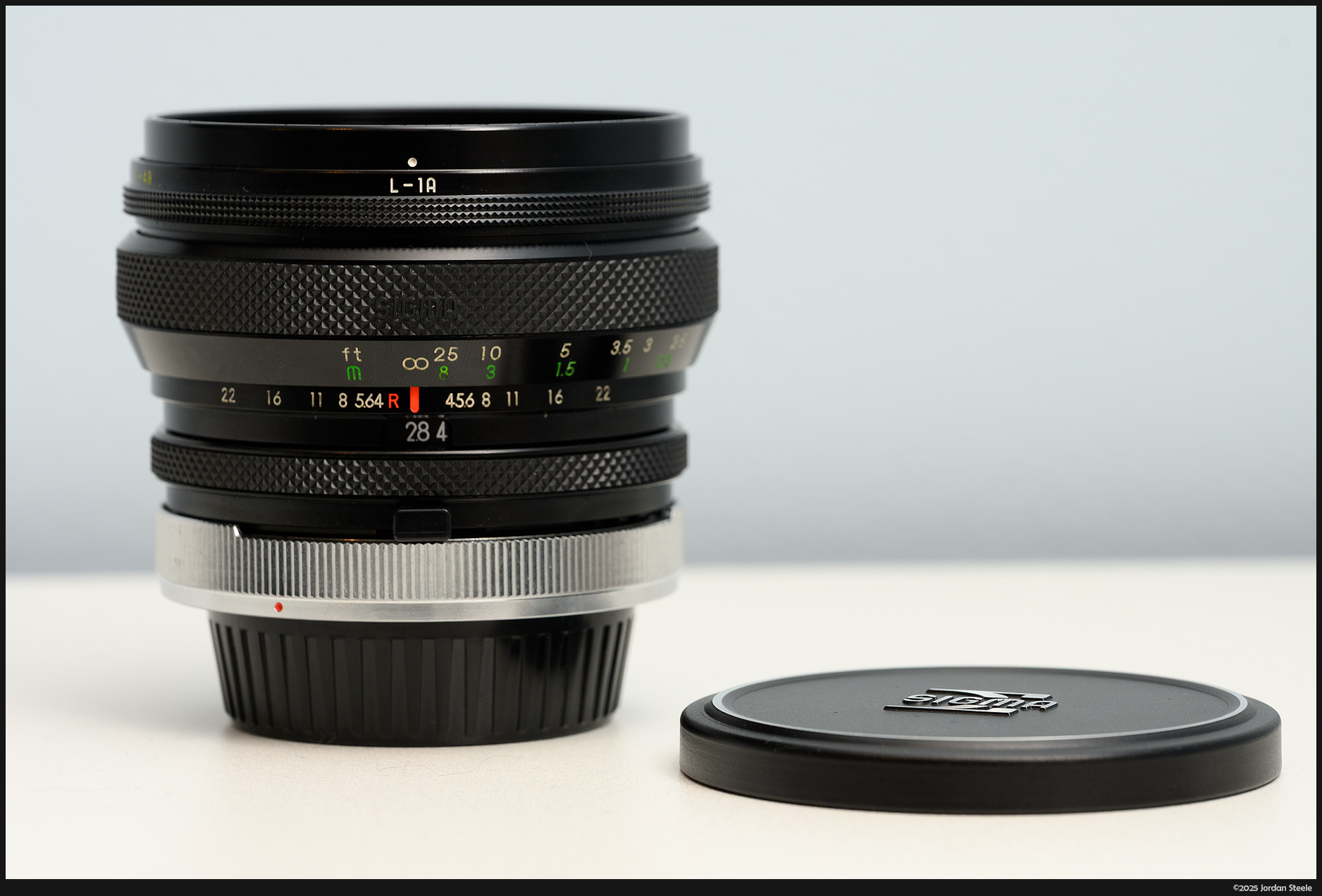
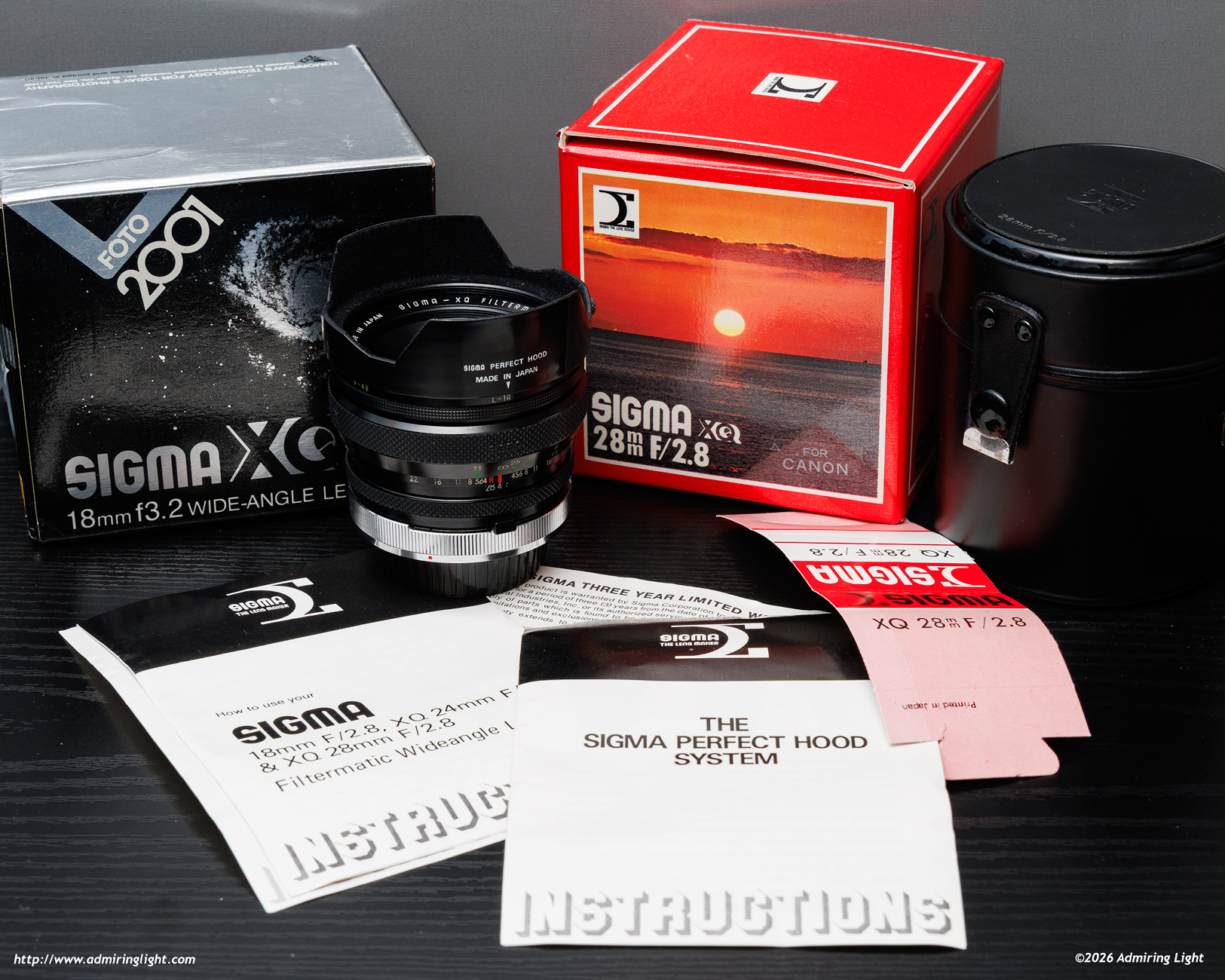
The lens is slightly larger than other manual focus 28mm f/2.8 lenses I’ve used, due to the filter system, but it’s still a lightweight lens, and feels great in the hand or on the camera. The 28mm came with a plastic lens hood that is friction fit and can only be mounted once the lens cap is removed. As far as I’m concerned, that makes it a no-go for actual use, so I just keep it in the leather lens case that also accompanied the lens. Below you can see these items, aslong with the more colorful box for the 28mm, and the documentation included with the lens.
The 28mm f/2.8 is a better lens overall than the 18mm, as one would expect for a much more standard wide angle design. However, it is also not a great lens by modern standards. It shows good central sharpness and even decent edge sharpness when stopped down, but contrast is quite low overall, and there is quite a lot of vignetting. The filters for black and white conversion make a little less sense on digital, since digital B&W conversion can effectively adjust the luminance of each color channel anyway, replicating the effects of a color filter without losing any light. The second shot is taken from the same spot, but using the built-in orange filter, and then converted to black and white in Lightroom. The use of the orange filter costs around a stop and a half of light in comparison to the first shot (1/250s vs 1/80s).


While I probably will only use these lenses when I really want a vintage look, for the low price paid, they’re great to have just as a part of Sigma’s history. While they are certainly nothing special in the optics department, they provide a unique look into Sigma’s first attempts at building professional-grade lenses.


Leave a Reply